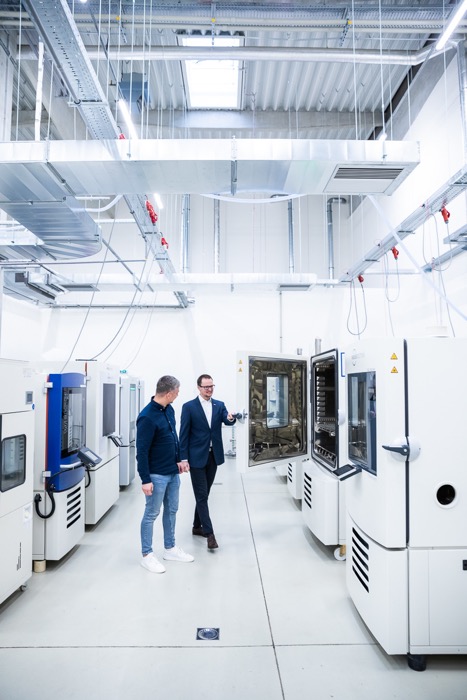
„The testing chamber, and the staff's approach and willingness beyond requirements — I can only recommend them.“
Tomáš Matús
Google review


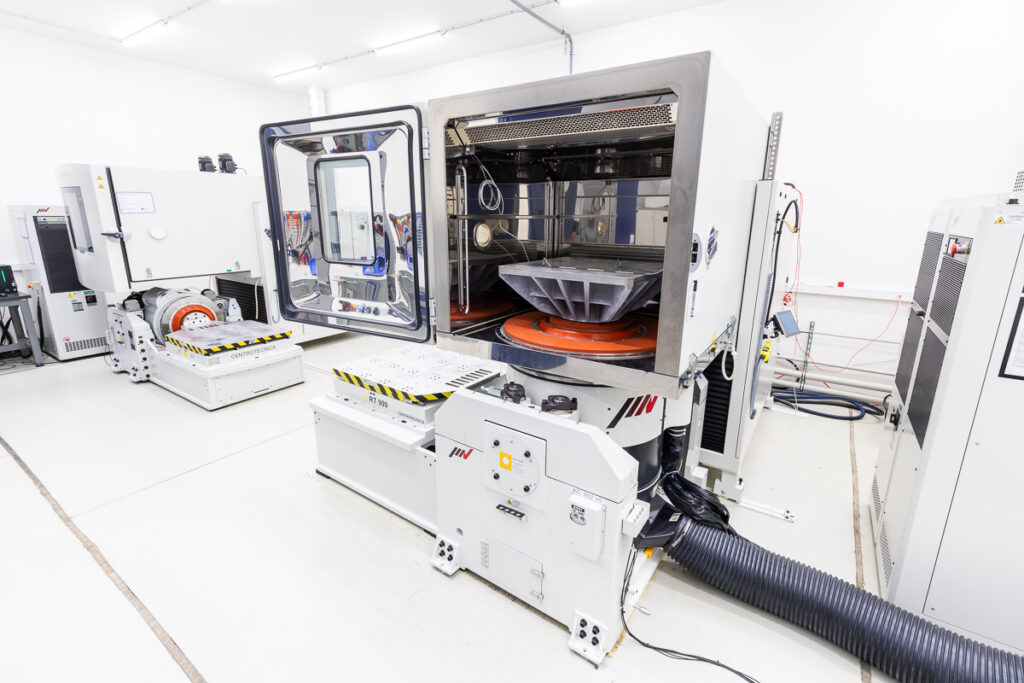
From the launch of the carrier rocket to years of operation in orbit – a satellite must withstand an environment that does not forgive mistakes. In our testing laboratory we simulate extreme vibrations during lift-off, sharp temperature fluctuations, deep vacuum and intense solar radiation. Using state-of-the-art vibration and thermal-vacuum tests, we reveal design weaknesses before the satellite sets off on its journey, thus helping to ensure its reliable operation even on the most demanding missions.
Sine sweep tests are among the basic steps in the mechanical verification of satellites and their sub-components. The sample is subjected to harmonic oscillation with a linearly or logarithmically changing frequency within a defined range. This makes it possible to precisely identify the natural (resonant) frequencies of the structure and its sensitive parts. This information is crucial for the subsequent setting of test profiles as well as for design modifications that will prevent dangerous amplification of vibrations during flight.
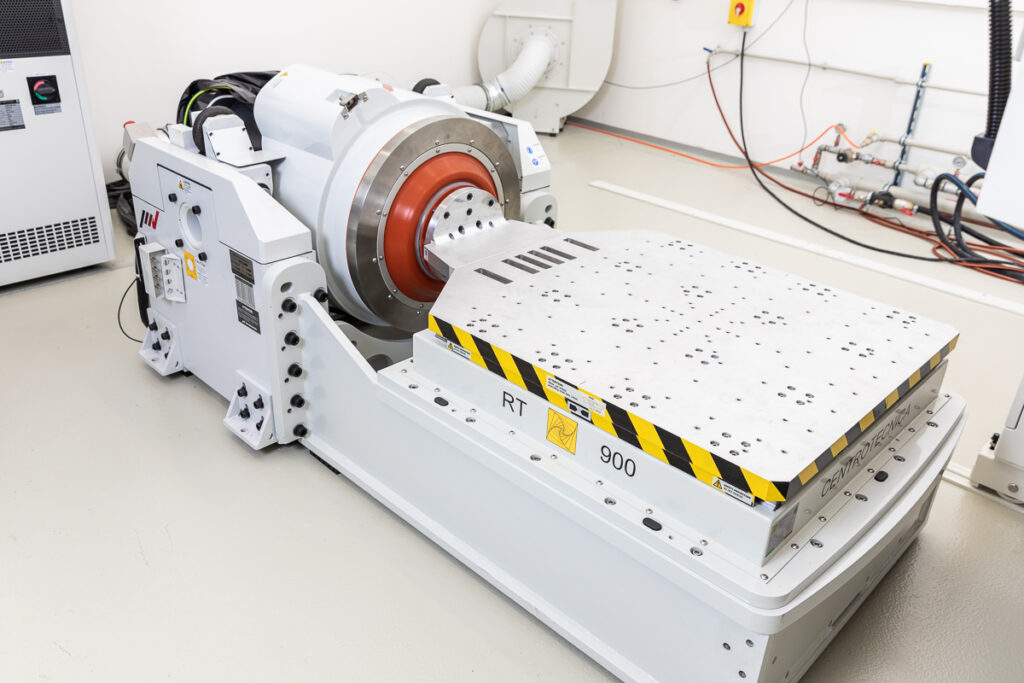
Random vibration tests simulate the real dynamic load to which the satellite is exposed during the launch of the carrier rocket. Vibrations in this mode are not harmonic but have a random character with a defined power spectrum over a wide frequency range. This type of test verifies whether the structure and mounting of all components will withstand the effects of vibrations, when the highest mechanical stress occurs.
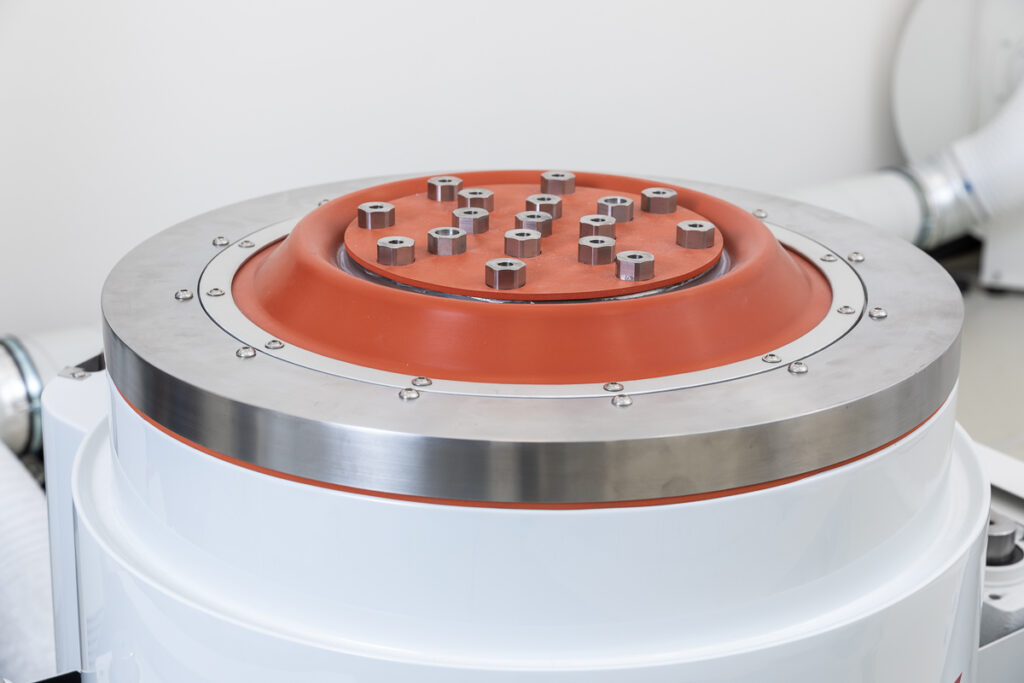
The sine burst test represents a short-term harmonic load with high amplitude and low frequency. It serves to verify resistance to intense shock and vibration phenomena that may occur, for example, during the separation of individual rocket stages or during the jettisoning of the aerodynamic fairing. This test helps to reveal design weaknesses that would otherwise remain hidden in ordinary vibration profiles.
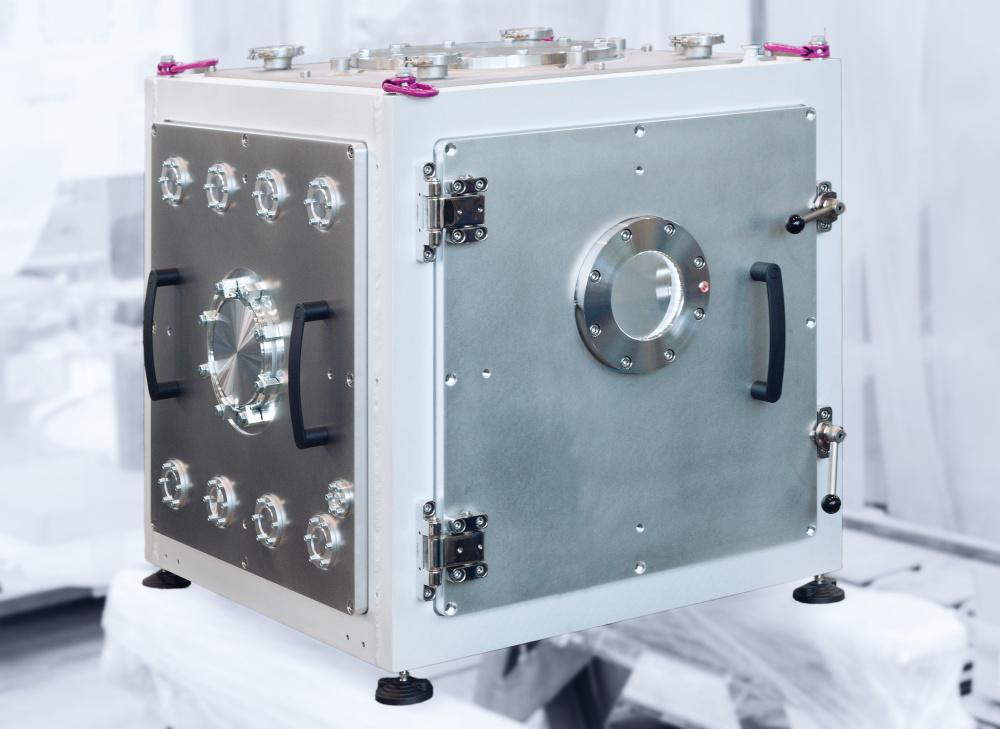
Thermal-vacuum tests are essential for verifying the functionality of the satellite under the conditions that prevail in space. In the chambers we are able to achieve a deep vacuum and simultaneously carry out temperature cycles. This simulates the extreme transitions between the illuminated and shaded sides of the satellite in orbit. TVAC tests reveal problems associated with heat dissipation, the functionality of moving parts in a weightless environment, and the reliability of electronics under conditions where there is no atmosphere for heat transfer by convection.

We'll be happy to advise you.
Ing. Radek Lovětínský
Head of the testing laboratory
In our laboratory we perform vibration tests, including more complex combined profiles, according to standards as well as specific customer requirements. We record the course of the test using the K2+ software. The customer can be personally present throughout the entire test and monitor its course in real time.
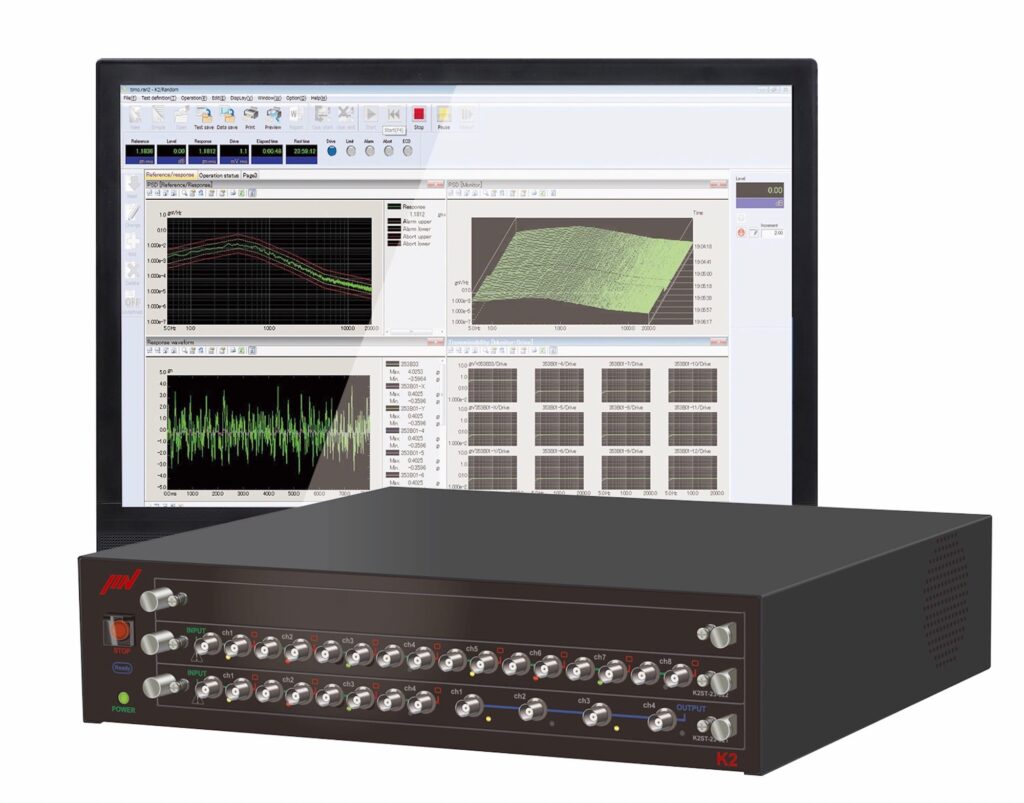
For better analysis of the behaviour of the tested satellite, we are able to measure acceleration on up to 20 channels, which means, for example, a combination of 2 single-axis accelerometers for control and 6 triaxial accelerometers on the sample (satellite).
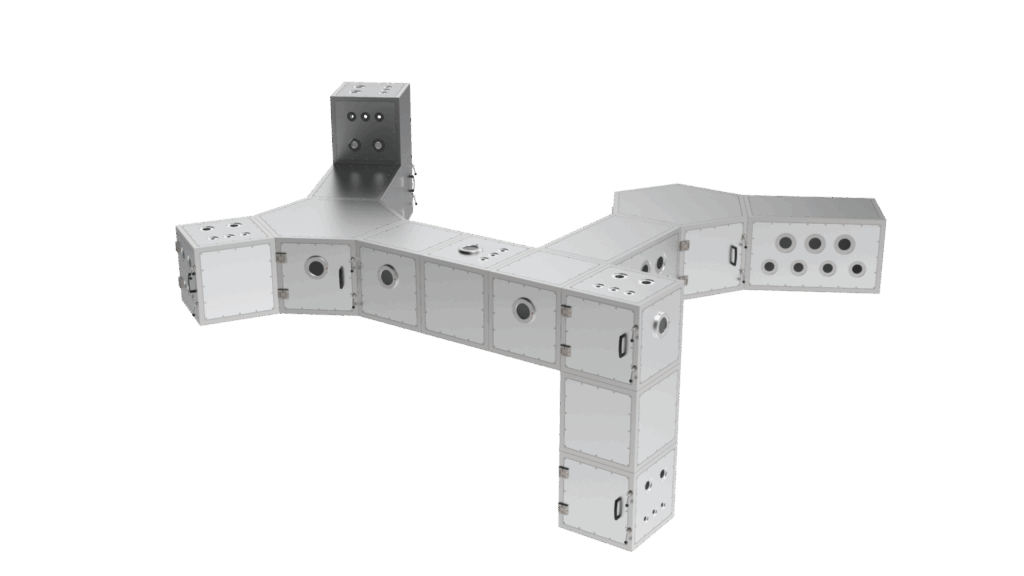
In the event that more feedthroughs or a different measurement set-up are required for the thermal-vacuum test, it is possible to replace the entire wall of the Streicher chamber with another one.
We test many different tests for you according to international standards, primarily for simulating a rocket launch and simulating the real conditions in space. It is of course also possible to arrange a custom test procedure according to your requirements.
Tell us your testing requirements (e.g. via the inquiry form, email or phone).
We contact you and clarify the test specification and timeline.
You receive a structured price quotation from us.
After your order we reserve the date and capacity.
You deliver the samples to us in person or by courier.
We carry out the test on the reserved date.
After the test we send the test report electronically.
We'll gladly go through the test results with you.
„The testing chamber, and the staff's approach and willingness beyond requirements — I can only recommend them.“
„JD Dvořák — a company where the impossible does not exist and where it is not only about work. I am glad to have the honour of working with JD Dvořák.“


„We have worked with JD Dvořák for a long time in testing, the rental of climatic chambers, and the service and calibration of our equipment. We value the helpfulness and professionalism of the department heads and technicians we are in regular contact with during tests and the work carried out. Our technicians also make use of training in various areas of testing, which provides both an expansion of theoretical knowledge and practical demonstrations.“

„What I greatly appreciate is the personal approach to solving every problem. Whether it concerned specific testing requirements or the need for individual consultation, I was always met with willingness and expert help that led to a smooth and efficient collaboration. For me, JD Dvořák is not only a professional company, but also an excellent partner in research and education.“

„We have worked with JD Dvořák since 2020. Since then we have completed several installations together, and throughout they have provided service and the necessary calibrations, always at the highest professional level. They have also helped us with our special requirements and we can always rely on them. Their approach is not only professional and customer-oriented, but also very human, and the cooperation is always pleasant.“

„Cooperation with JD Dvořák is at an excellent level, as proven by more than 20 years of trouble-free collaboration.“

„You do good work — thank you for the long-term cooperation.“

„Thank you for the professional cooperation so far. You are a very reliable partner for us.“

This document contains key information about the tested sample and the course of the test. We provide the report in Czech or English according to your needs.
We issue both an accredited and a non-accredited test report according to customer requirements. The type of report is determined by the chosen testing standard.
Not sure how to test your sample? We'll help. We have years of experience and will recommend the most suitable procedure. And if you already know exactly what you want, we'll be your partner — without unnecessary questions.
Our equipment covers most requirements. If something is missing, thanks to our links with manufacturers of testing technology we can often arrange even specialised equipment outside our laboratory.
You can rely on both the equipment and our arrangements. We service and calibrate everything ourselves, so we can react quickly and adapt tests to get you results as soon as possible.
Every job is unique to us. We always try to understand your needs and tailor the service exactly to what you expect.
We'll be happy to advise you.
Ing. Radek Lovětínský
Head of the testing laboratory
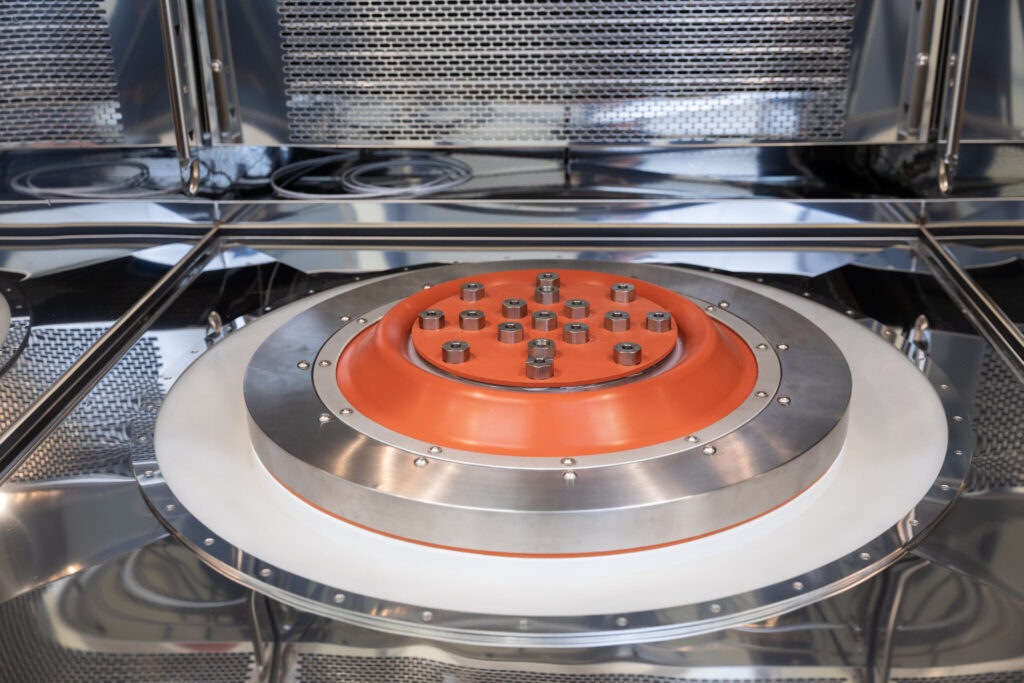
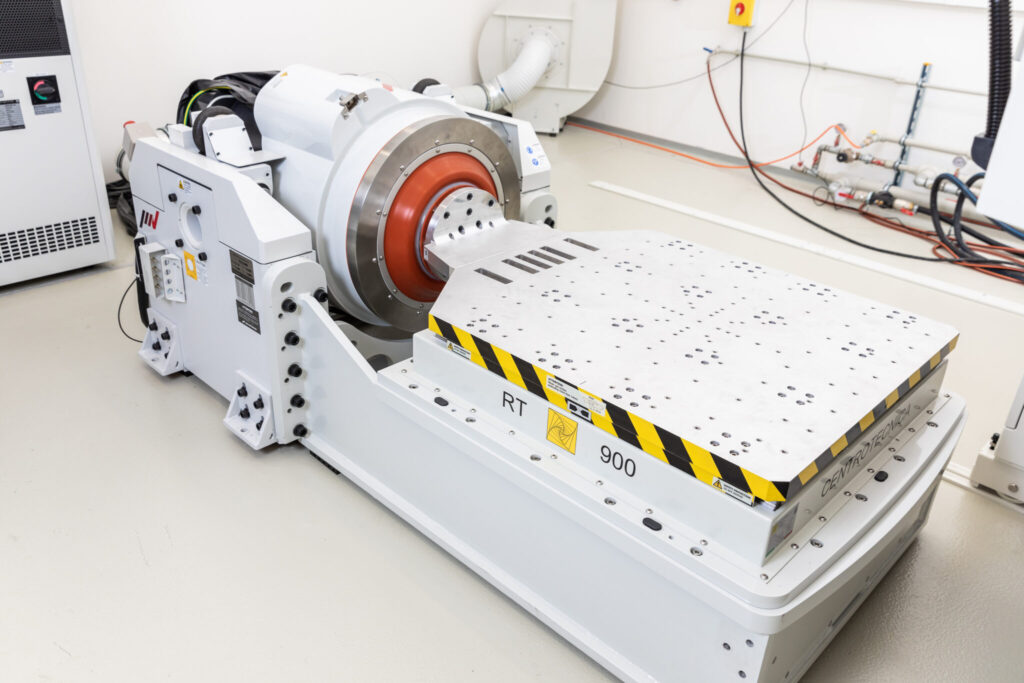
We test according to international standards, for example ECSS, ISO 14644 or NASA GEVS, and we are able to adapt to specific customer requirements as well.
Yes, we welcome the customer's presence during the tests. It allows for immediate consultation of the results and any adjustments.
Yes, for example vibration tests in combination with temperature cycles or TVAC tests. These tests better reflect the real conditions in orbit.
A temperature range from –70 °C to +200 °C and a vacuum of up to <10⁻⁶ mbar, which corresponds to the conditions in orbit as well as during interplanetary missions.