„The testing chamber, and the staff's approach and willingness beyond requirements — I can only recommend them.“
Tomáš Matús
Google review

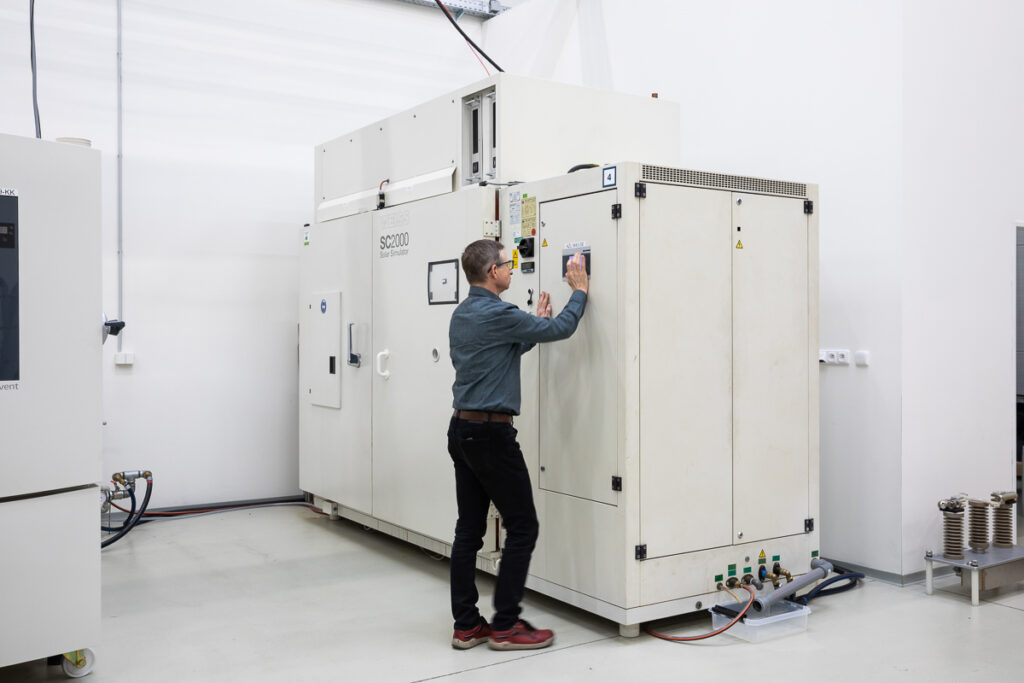
In our environmental-effects laboratory we carry out non-accredited tests simulating full-spectrum solar radiation. We test materials, parts and complete assemblies under the controlled action of UV, visible and infrared radiation. The tests are performed under both steady and cyclic conditions of temperature and humidity, in accordance with international standards as well as specific customer requirements.
Full-spectrum solar simulation tests make it possible to faithfully reproduce the effect of solar radiation on products and materials throughout their entire life cycle – from development to operation under real conditions. They use a combination of UV, visible and infrared radiation that corresponds to the natural solar spectrum. The tests are conducted not only under stable laboratory conditions but also under changing climatic influences, such as extreme temperature differences, high humidity or alternating day cycles. This comprehensive approach makes it possible to simulate a real operating environment and to verify the resistance of products to ageing, deformation, colour change or functional failures caused by solar radiation and climatic loading.
Outdoor (outdoor) – simulate loading by external influences and radiation with a value of 1000 W/m2 +-100 W/m2
Indoor (indoor) – the samples are loaded with radiation of 830 W/m2 +-80 W/m2
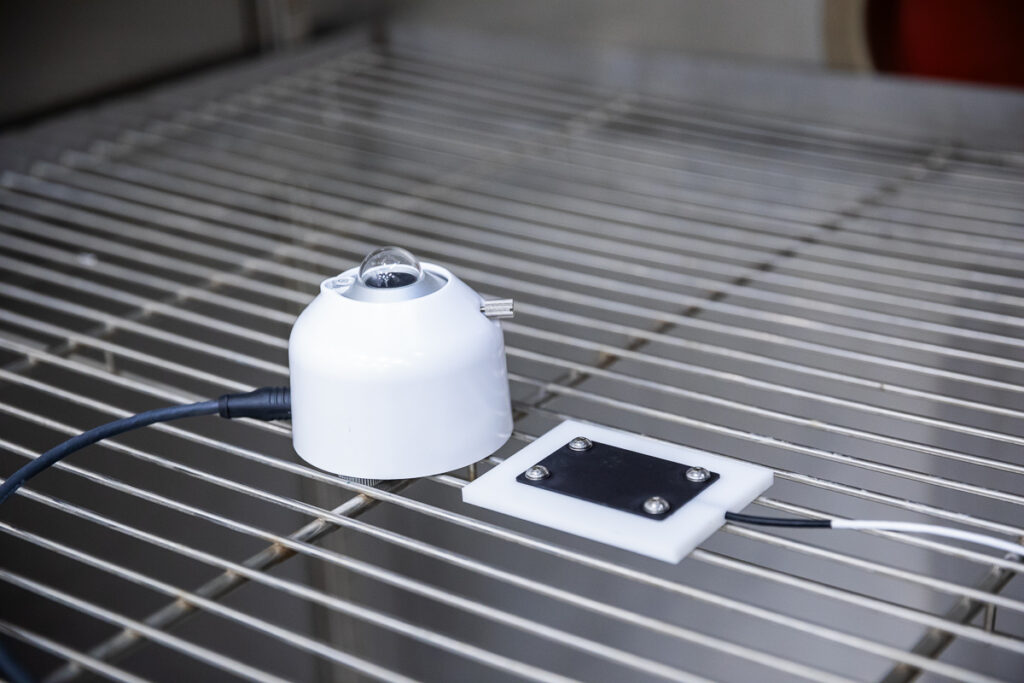

We'll be happy to advise you.
Ing. Radek Lovětínský
Head of the testing laboratory
The test chamber for solar simulation is equipped with two metal-halide discharge lamps with a total output of 8 kW, which generate full-spectrum radiation in the range of 280 to 3000 nm, faithfully reproducing natural sunlight including the UV, visible and infrared spectrum. The maximum radiation intensity reaches up to 1200 W/m², allowing accelerated ageing of materials even under extreme conditions. The chamber enables temperature control from –30 °C to +100 °C without an insulating cover, as well as humidity control in the range of 10–80 % relative humidity during the irradiation itself. The internal test space has a volume of up to 3400 litres, which allows the testing of larger assemblies or complete vehicle components.
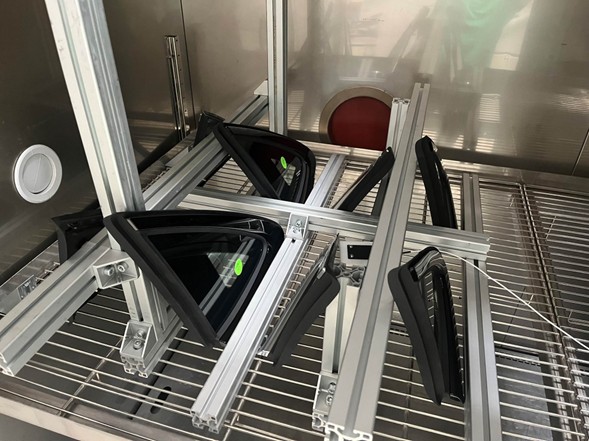
The Z-OUT-T test according to VDA 230-219 or PR 263 evaluates the resistance of automotive glazing to solar radiation, particularly with regard to changes in appearance and optical properties. Its requirements correspond to the solar radiation simulation method according to the DIN 75220 standard.
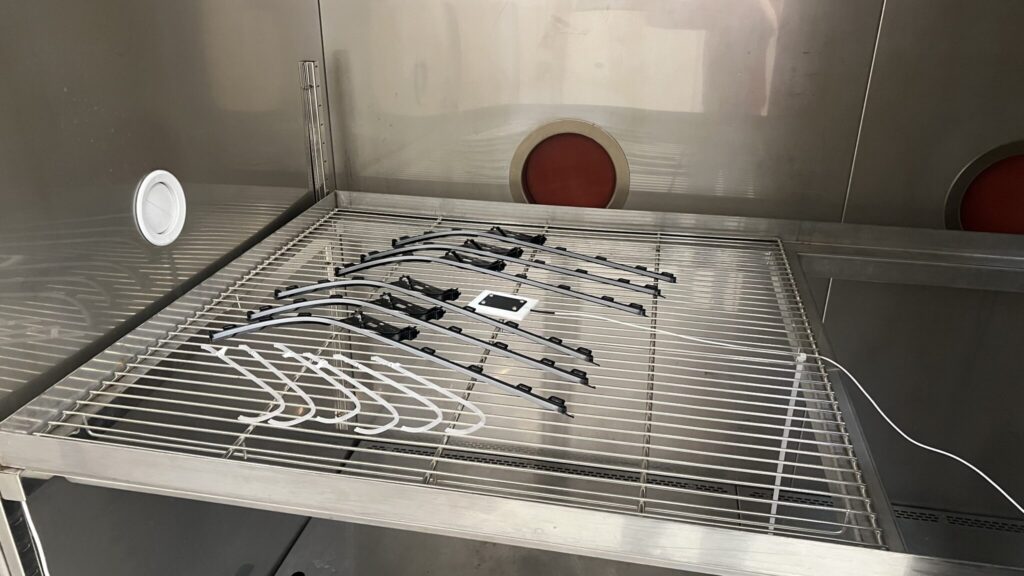
The Z-IN1 test according to DIN 75220 verifies the resistance of interior lighting parts to solar radiation. It is carried out with a filter glass that simulates the transmission of light through automotive glazing.
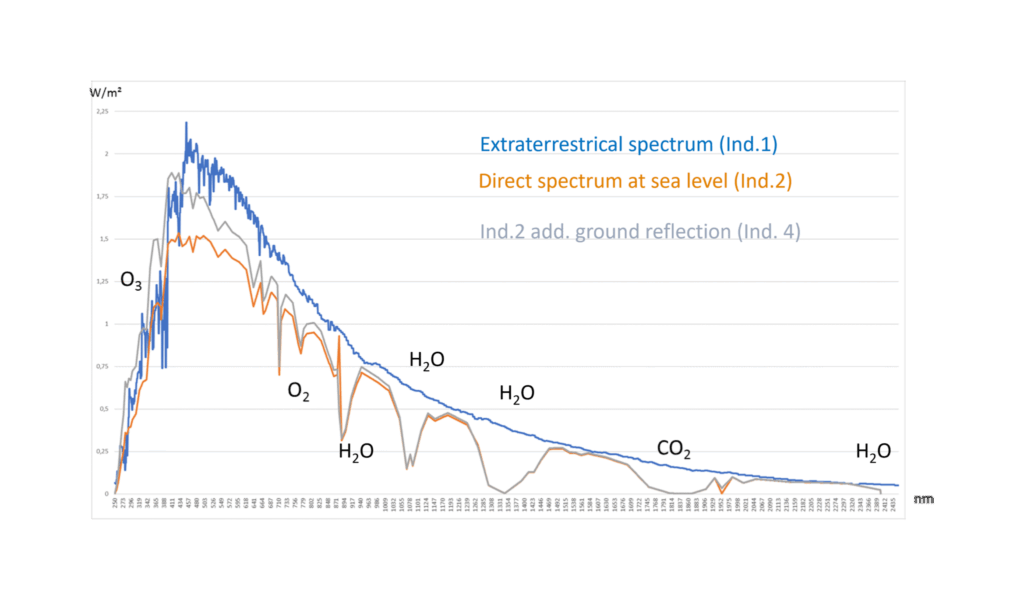
CIE Publication No. 85, Table 4 defines the reference spectrum of solar radiation on a surface with a 37° inclination. It serves as a standard for testing materials and solar simulators and covers UV, visible and IR radiation. Although the standard is older (1999), it is still widely used as a baseline reference source.
Our laboratory carries out material testing according to the DIN 75220 standard, which evaluates the behaviour of, for example, automotive parts during ageing in a simulated environment. We focus mainly on polymer components and their response to artificial radiation, temperature and humidity, with the aim of identifying changes such as shape, colour, gloss or strength.
We offer two main types of test:
After the test, the samples are evaluated using both non-destructive (e.g. appearance, colour) and destructive methods in the materials section of our laboratory.
Tell us your testing requirements (e.g. via the inquiry form, email or phone).
We contact you and clarify the test specification and timeline.
You receive a structured price quotation from us.
After your order we reserve the date and capacity.
You deliver the samples to us in person or by courier.
We carry out the test on the reserved date.
After the test we send the test report electronically.
We'll gladly go through the test results with you.
„The testing chamber, and the staff's approach and willingness beyond requirements — I can only recommend them.“
„JD Dvořák — a company where the impossible does not exist and where it is not only about work. I am glad to have the honour of working with JD Dvořák.“


„We have worked with JD Dvořák for a long time in testing, the rental of climatic chambers, and the service and calibration of our equipment. We value the helpfulness and professionalism of the department heads and technicians we are in regular contact with during tests and the work carried out. Our technicians also make use of training in various areas of testing, which provides both an expansion of theoretical knowledge and practical demonstrations.“

„What I greatly appreciate is the personal approach to solving every problem. Whether it concerned specific testing requirements or the need for individual consultation, I was always met with willingness and expert help that led to a smooth and efficient collaboration. For me, JD Dvořák is not only a professional company, but also an excellent partner in research and education.“

„We have worked with JD Dvořák since 2020. Since then we have completed several installations together, and throughout they have provided service and the necessary calibrations, always at the highest professional level. They have also helped us with our special requirements and we can always rely on them. Their approach is not only professional and customer-oriented, but also very human, and the cooperation is always pleasant.“

„Cooperation with JD Dvořák is at an excellent level, as proven by more than 20 years of trouble-free collaboration.“
„You do good work — thank you for the long-term cooperation.“
„Thank you for the professional cooperation so far. You are a very reliable partner for us.“

This document contains key information about the tested sample and the course of the test. We provide the report in Czech or English according to your needs.
We issue both an accredited and a non-accredited test report according to customer requirements. The type of report is determined by the chosen testing standard.
Not sure how to test your sample? We'll help. We have years of experience and will recommend the most suitable procedure. And if you already know exactly what you want, we'll be your partner — without unnecessary questions.
Our equipment covers most requirements. If something is missing, thanks to our links with manufacturers of testing technology we can often arrange even specialised equipment outside our laboratory.
You can rely on both the equipment and our arrangements. We service and calibrate everything ourselves, so we can react quickly and adapt tests to get you results as soon as possible.
Every job is unique to us. We always try to understand your needs and tailor the service exactly to what you expect.
We'll be happy to advise you.
Ing. Radek Lovětínský
Head of the testing laboratory
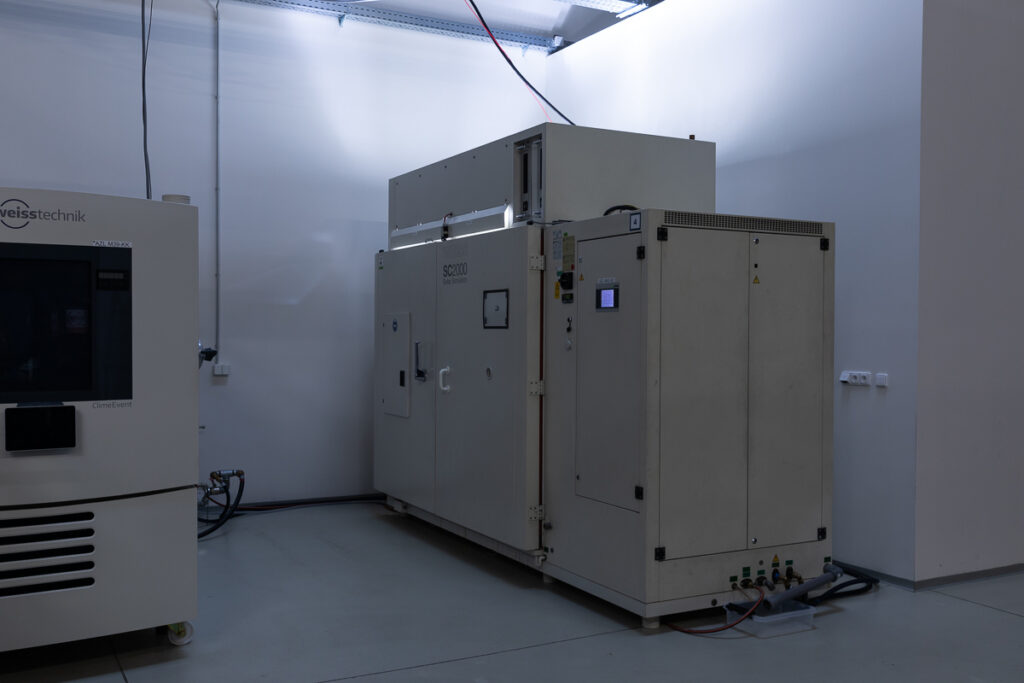
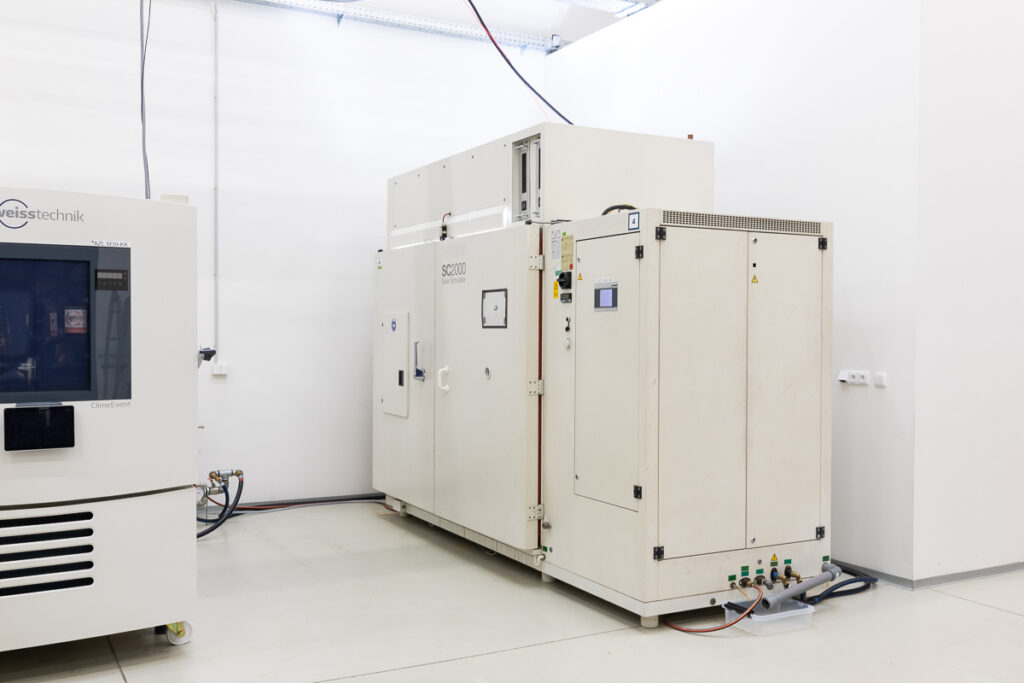
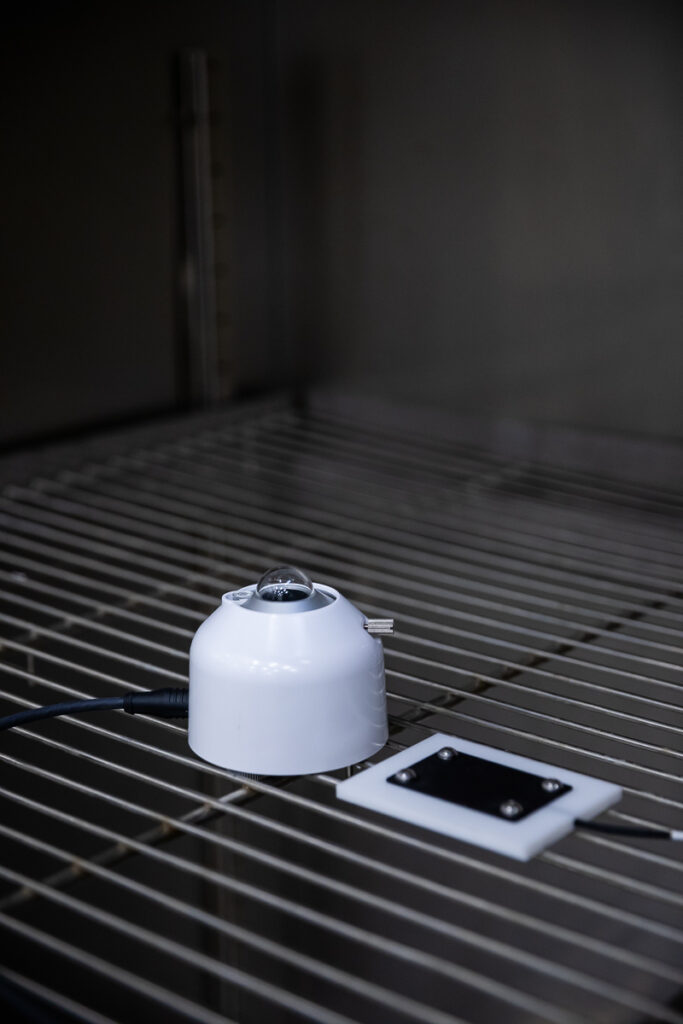
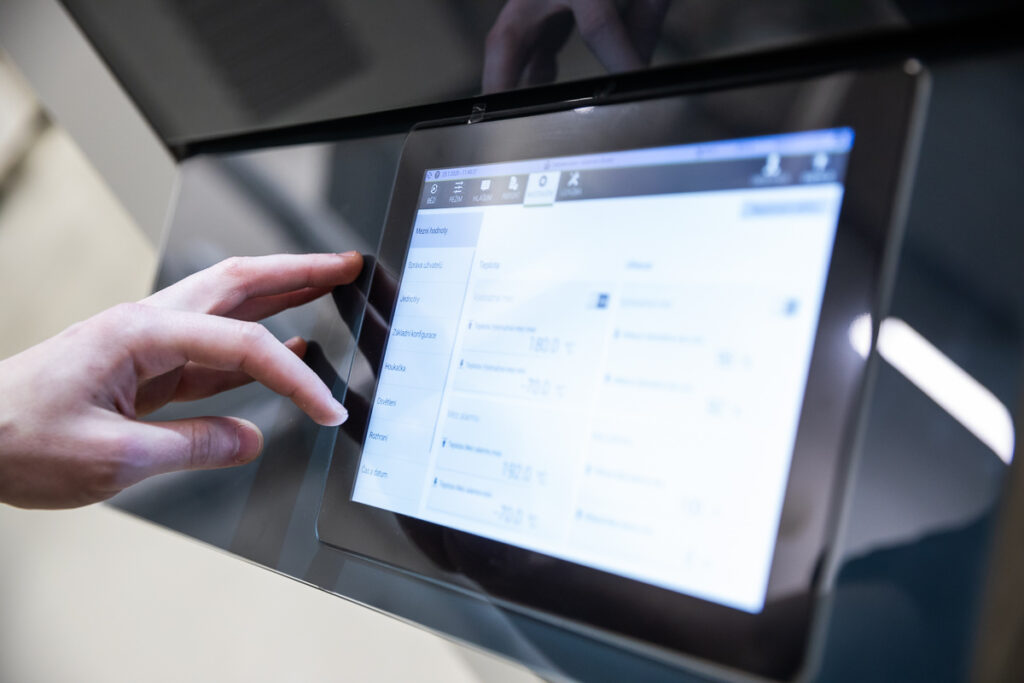
A solar simulation test simulates the action of solar radiation on a product under laboratory conditions. It serves to determine how components or entire products withstand intense sunlight – for example in terms of heating up, colour changes, ageing of materials or degradation of plastics.
One of the most frequently used standards is DIN 75220, which is typical for the automotive industry. Standards such as VDA 230-219 are also often used, as well as the specifications of individual manufacturers (OEMs). The choice of standard depends on the type of product and the required application scenario.
Solar simulation tests can be performed on a wide range of products – from plastic parts, textiles and painted surfaces, through electronics and sensors, to complete vehicle interior or exterior assemblies. The testing is suitable both for the automotive industry and for construction, consumer electronics or the defence industry.
The tested sample is placed in a chamber with a solar simulator that emits full-spectrum light (including UV, visible and IR radiation). At the same time, temperature, humidity and, where applicable, airflow are controlled. The testing time can range from several hours to tens of days – depending on the standard and the required load.
The sample should correspond to the real product or a representative of it – ideally including the material composition, surface treatments and assembly conditions. In some cases it is also necessary to supply a fixture for mounting, a description of the sample's function and the criteria for its evaluation after the test (e.g. colour changes, deformation, functionality).
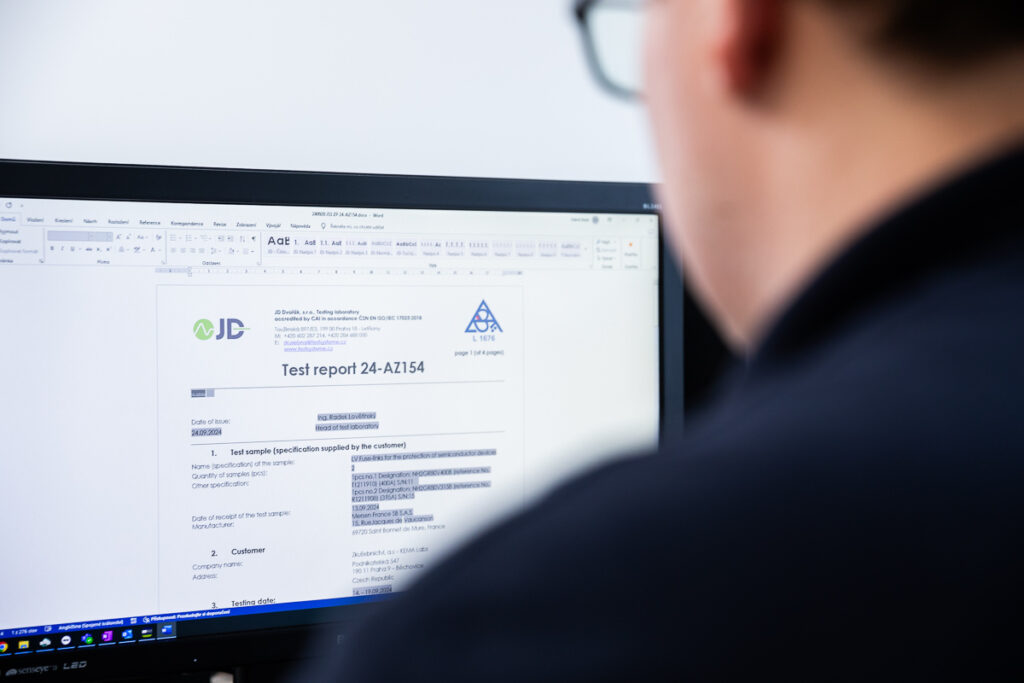
After the test you receive a report containing details of the course of the test, the conditions used, a photograph of the sample, and above all the results – that is, whether the sample passed according to the required criteria. The results can be used for certification, internal development or as proof of quality towards a customer or OEM.